
Breadcrumbs
- You are here:
-
Home

-
Uncategorised
- Food Web Builder - Level 1
Research
Research
Research digests from Open Educational Resources / Open Source Physics @ Singapore. Each article translates a paper into classroom moves, implementation notes, and related open resources.
- Hits: 1404
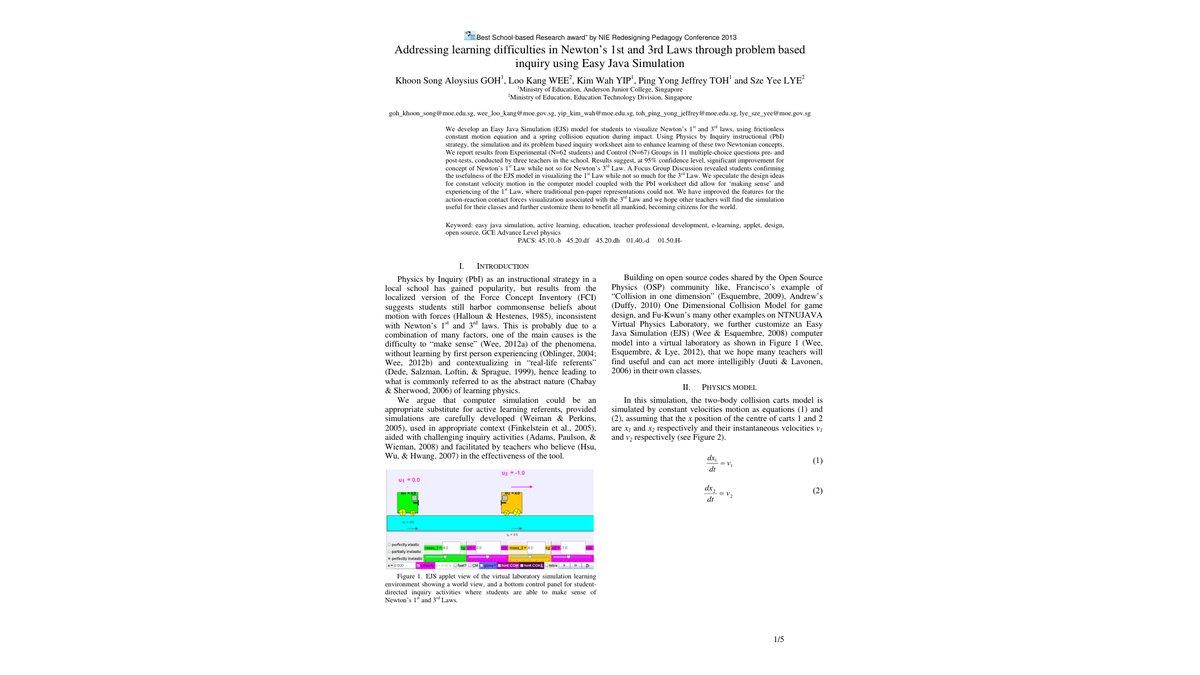
Research digest: The paper targets persistent misconceptions about force pairs, motion, and interaction. EJS is used to make otherwise invisible relationships inspectable so students can test ideas instead of memorising law statements.
Classroom use: Use a scenario where students predict forces, run the model, and revise the force explanation. Include both bodies in every interaction diagram.
- Hits: 1042
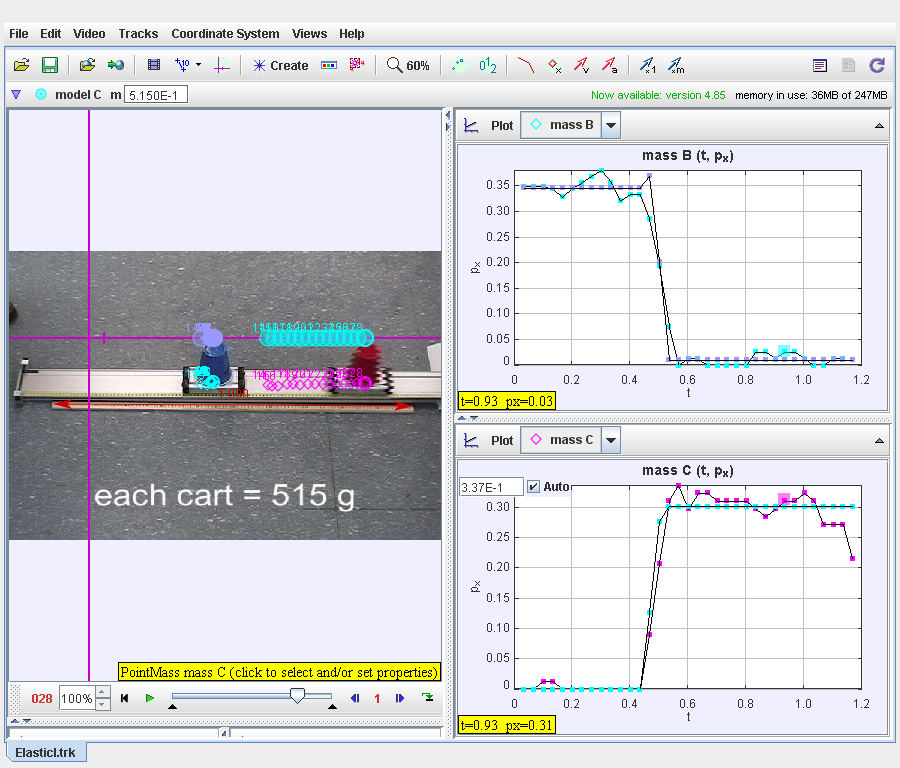
Research digest: The paper uses a collision cart model to support experiential learning of momentum and collisions. It is valuable because students can vary masses and velocities, then compare before-and-after quantities.
Classroom use: Ask students to predict the outcome of elastic and inelastic collisions before running the model. Then compare total momentum and kinetic energy.
- Hits: 583
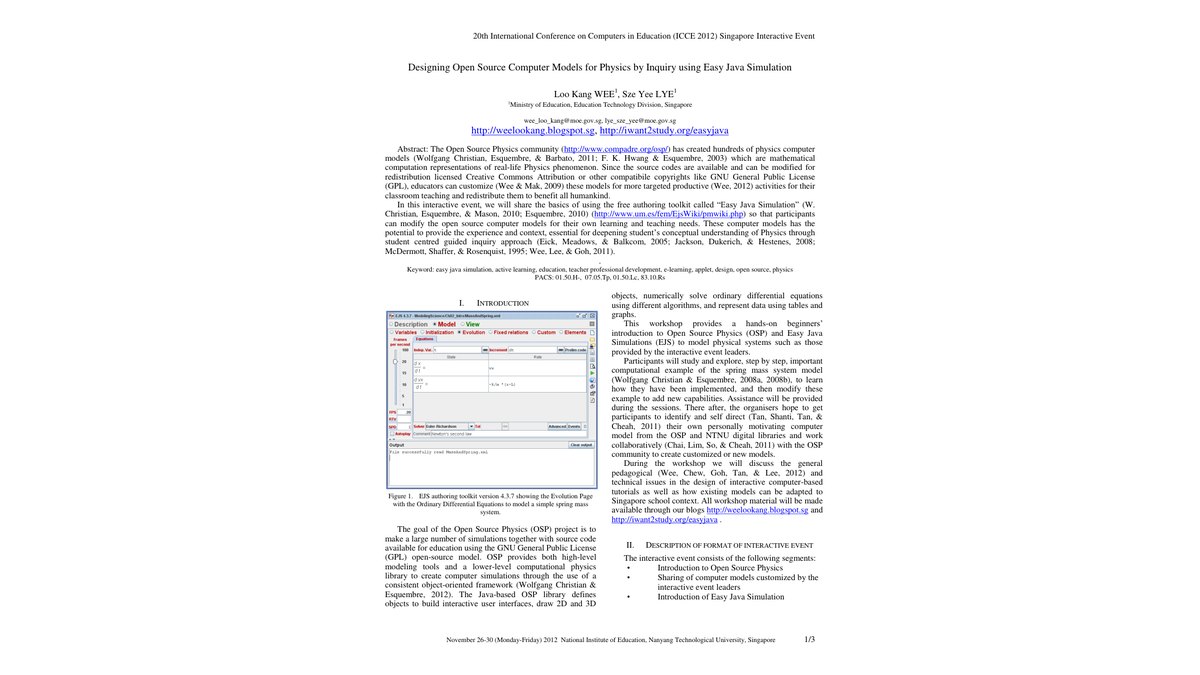
Research digest: This short paper links open-source model design to inquiry learning. It is especially useful for turning a simulation from a demonstration into an investigation.
Classroom use: Begin with a question, let students vary one key input, and require a claim supported by model evidence.
Read more: Designing Open Source Computer Models for Physics by Inquiry using Easy Java Simulation
- Hits: 845
Research digest: This paper uses Tracker to make projectile motion evidence-based. Students can separate horizontal and vertical motion from a real video, making the independence of components easier to justify.
Classroom use: Track a projectile video and compare x-time, y-time, vx-time, and vy-time graphs. Ask which graph shows constant velocity and which shows acceleration.
Read more: Using Tracker as a Pedagogical Tool for Understanding Projectile Motion
- Hits: 639
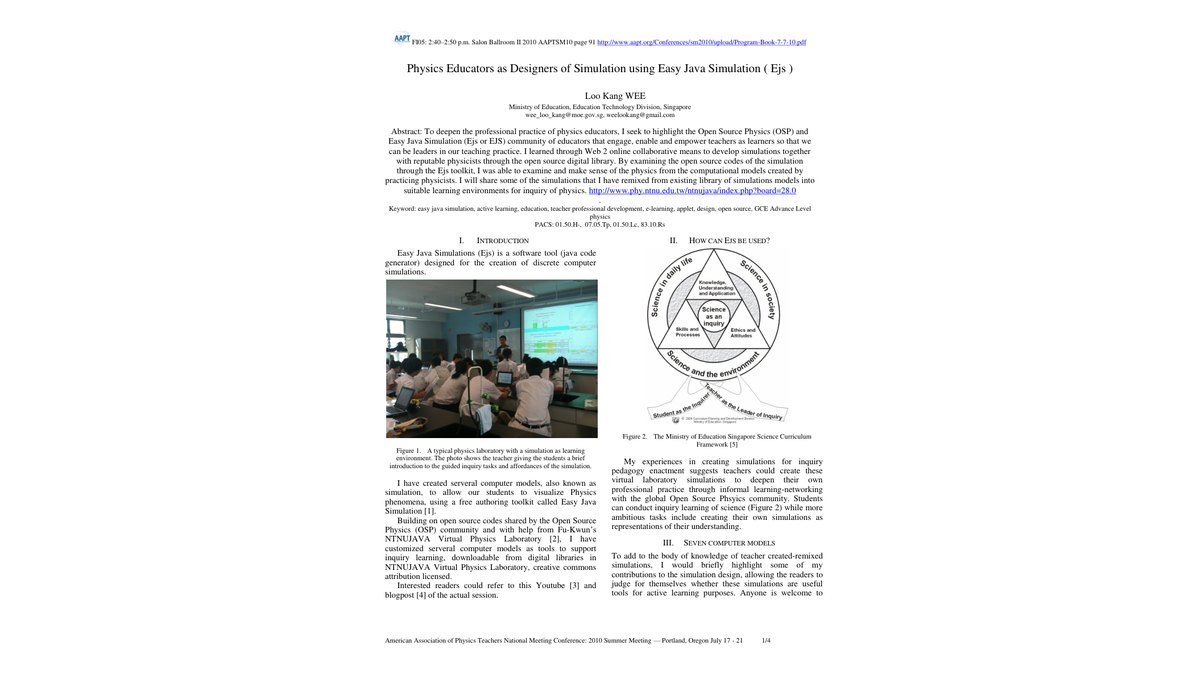
Research digest: This is an early articulation of a teacher-designer stance. The value is that teachers can build models around the exact conceptual bottlenecks they see in class.
Classroom use: Use it to introduce EJS as a design environment rather than a repository of finished applets.
Read more: Physics Educators as Designers of Simulation using Easy Java Simulation (Ejs)
- Hits: 632
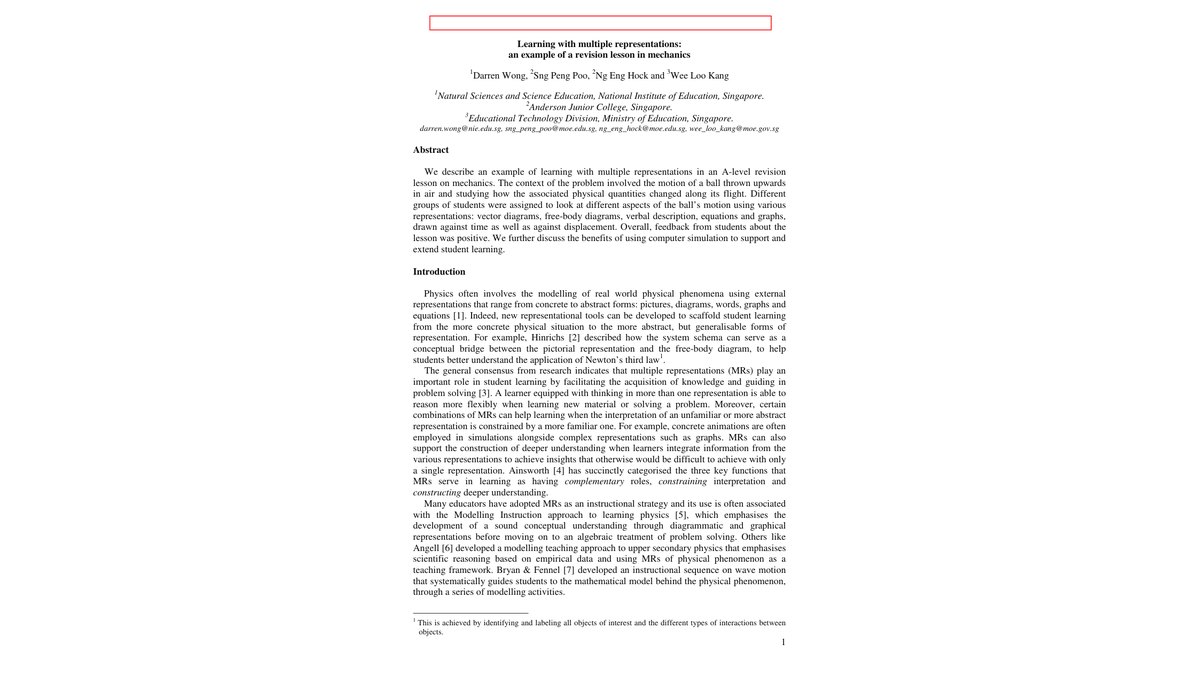
Research digest: The key idea is that students learn mechanics better when they coordinate diagrams, graphs, equations, and verbal explanations. It is directly applicable to revision lessons where students may know formulas but not representations.
Classroom use: Give one motion situation and ask students to produce a diagram, graph, equation, and explanation. Then compare the information each representation makes visible.
Read more: Learning with multiple representations: An example of a revision lesson in mechanics
- Hits: 600
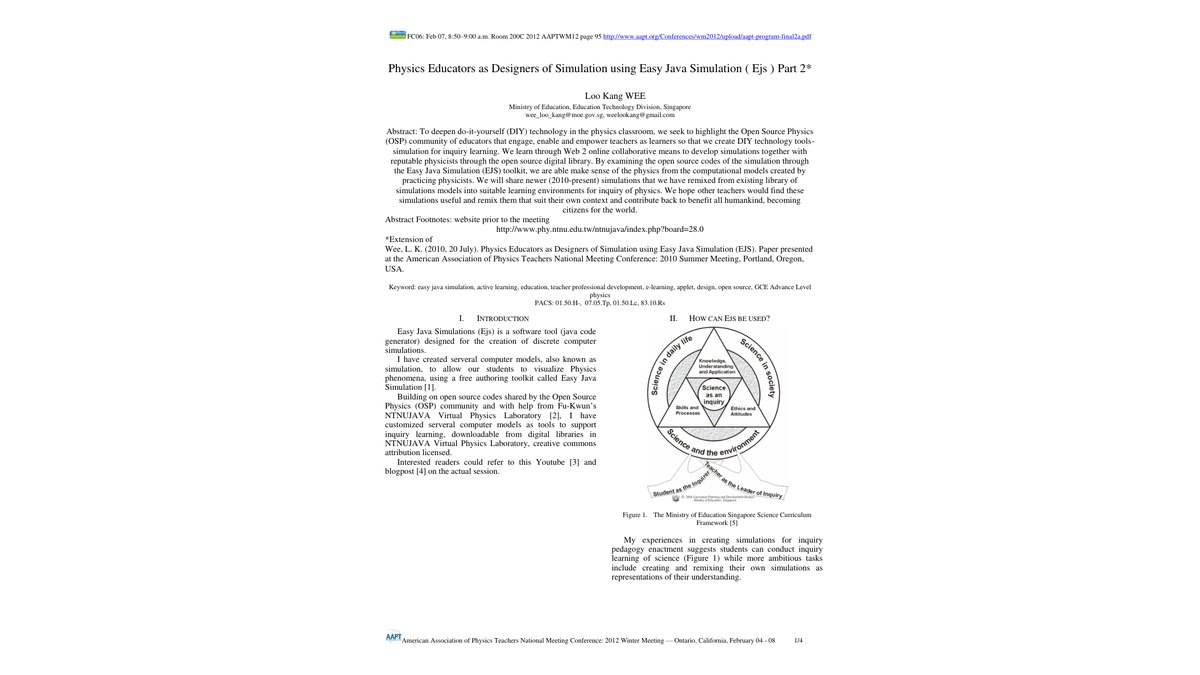
Research digest: This presentation continues the argument that teachers can design and adapt simulations. It is useful for professional learning because it treats simulation design as pedagogical design.
Classroom use: Use it for teacher workshops: begin with a working model, identify a learning difficulty, then modify the model or prompts to address that difficulty.
Read more: Physics Educators as Designers of Simulation using Easy Java Simulation (Ejs) Part 2
- Hits: 572
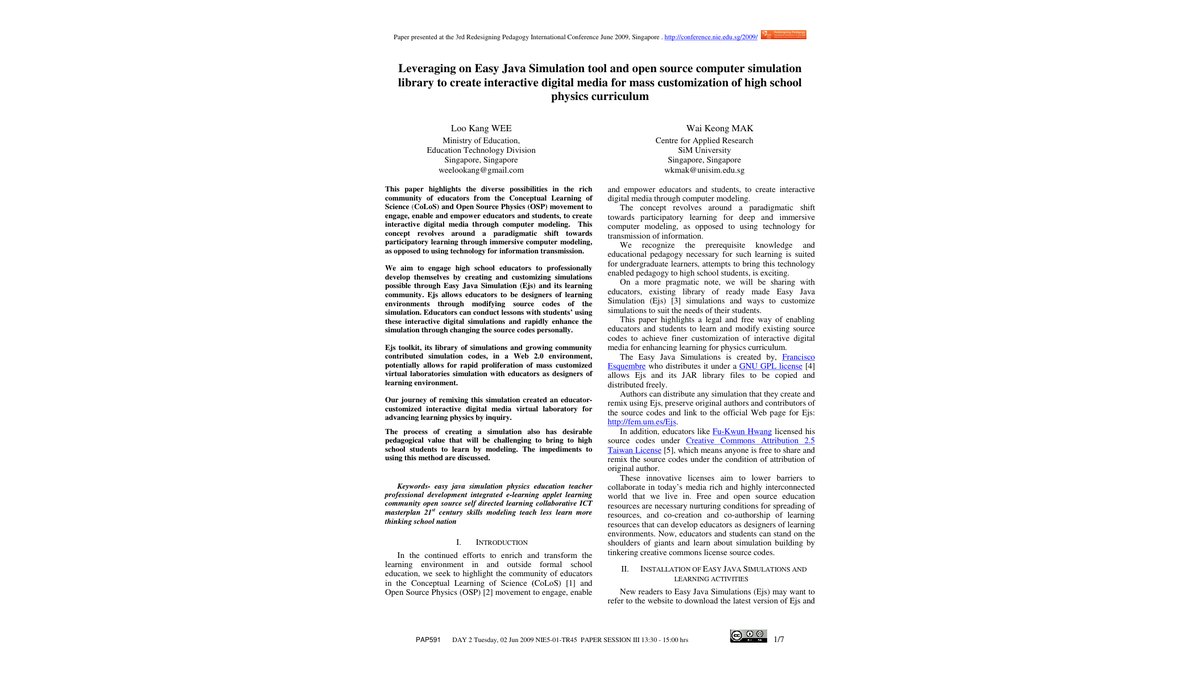
Research digest: This paper is about scalability and customisation: EJS and an open library make it possible to adapt resources for different high-school physics needs.
Classroom use: Use a common model as a base, then adjust context, prompts, or variables for a particular class or topic.
- Hits: 608
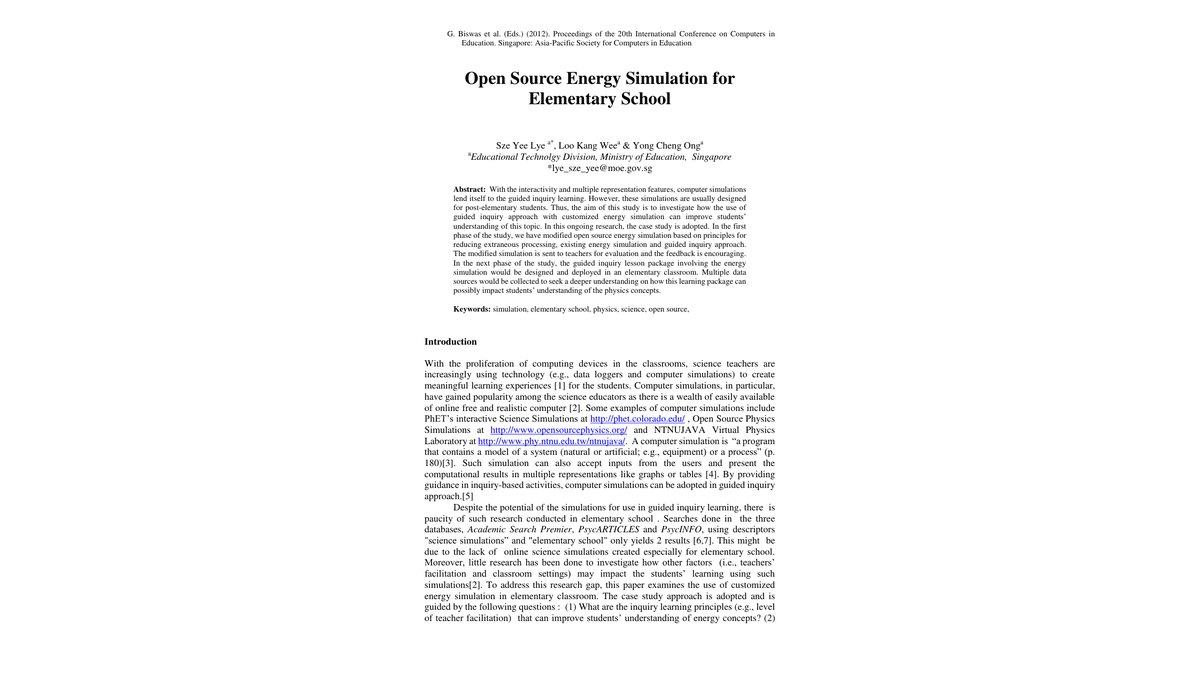
Research digest: The focus is elementary energy learning: students need visible, manipulable situations to talk about energy transfer and transformation. The open-source angle allows the activity to be adapted for local examples.
Classroom use: Use familiar contexts such as moving objects, springs, or heating. Ask students to identify the energy store or transfer before and after an event.
Read more: Open Source Energy Simulation for Elementary School
- Hits: 580
Research digest: The paper is workshop-oriented: it shows how video analysis can change the pedagogy of motion lessons. The teacher move is to give students authentic data and let them construct meaning from it.
Classroom use: Use a simple motion clip first, then move to student-collected videos. Build confidence in tracking, graph reading, and model comparison.
- Hits: 628

Research digest: The paper uses an EJS model to make geostationary orbit understandable as a condition involving period, radius, and Earth rotation. The model is useful because orbit concepts are spatial and dynamic.
Classroom use: Ask students what must be true for a satellite to remain above the same point on Earth. Then use the model to test period and radius changes.
Read more: Geostationary Earth Orbit Satellite Model using Easy Java Simulation