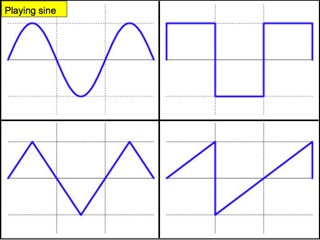
 Four basic waveforms.
 Four basic waveforms.
The Sound Waveforms JavaScript Model explores the aural texture of four basic periodic waveforms: sine, triangle, square, and sawtooth. The sine waveform has a single frequency and is the building block of other periodic waves by summing harmonics in a Fourier Series. The richness of the sound is called the timbre and is determined by the amplitude of the harmonics in the Fourier sum.
Click on the waveform image to hear the difference types of sounds these waveforms produce and drag up and down within the image to change the waveform frequency. Drag left and right to adjust the volume. The sine waveform produces the smoothest sound because it consists of a single fundamental frequency Fo. The triangle waveform has a richer and higher timbre because the dominant frequency Fo is joined by the odd harmonics 3Fo, 5Fo, 7Fo, etc. The square waveform also has only odd harmonics but it sounds higher than the triangle waveform because the amplitude of these harmonics is greater than for a triangle waveform. In other words, the triangle waveform more closely matches a sine waveform than the square waveform. The sawtooth waveform has the most complex timbre because every harmonic is present.
The Sound Waveforms JavaScript Model uses the HTML 5 Web Audio API. This API is still under development and may not be supported on all platforms. Try the Reset button to reinitialize the simulation if the sound does not play when the image is pressed.
The Sound Waveforms JavaScript Model was developed by Wolfgang Christian using version 5.2 of the Easy Java/JavaScript Simulations (EjsS) authoring and modeling tool. Although EjsS is a Java Program, it creates ready-to-run JavaScript simulations and ePubs. Information about EJS is available at: < http://www.um.es/fem/Ejs/> and in the OSP ComPADRE collection < http://www.compadre.org/OSP/>.