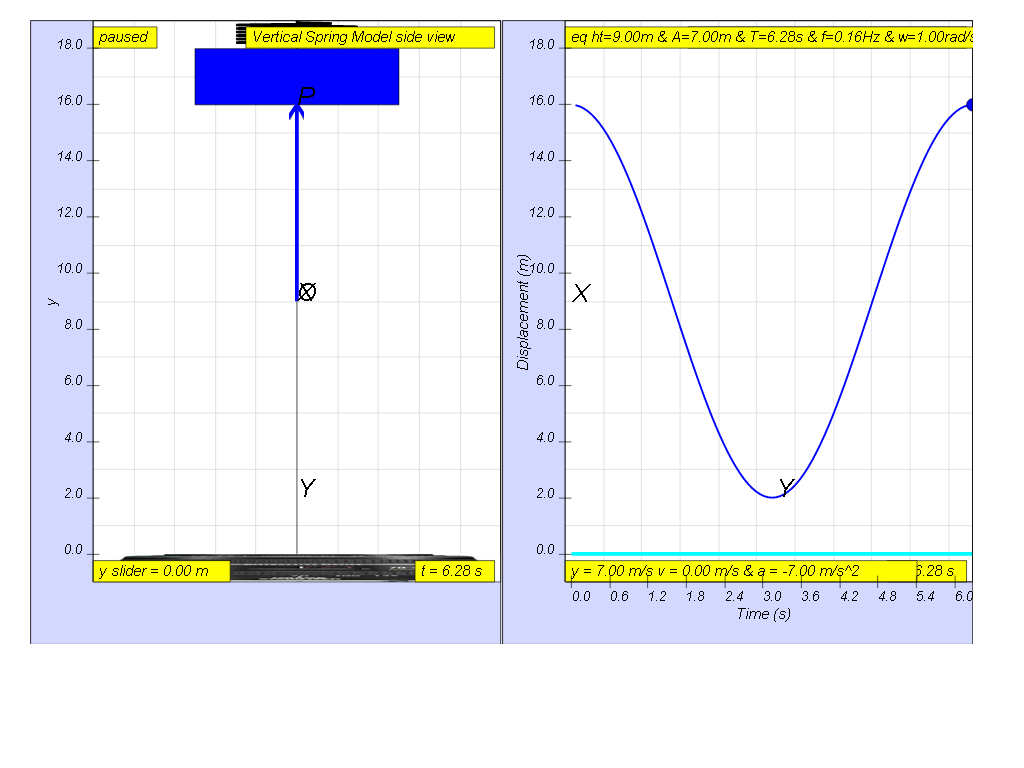
A mass undergoes an oscillation where the maximum/minimum amplitude is
16.0 m mark and 2.0 m mark on a rule respectively. It was found that the
particle only takes 3.14 s to move from X = 16.0 m to Y = 2.0 m during the
oscillations as shown. Determine the
(a) amplitude,
(b) period,
(c) frequency,
(d) angular frequency, of the oscillations.
[ 7.0 m, 6.28 s, 0.166 Hz, 1.00 rad/s ]
Q1: run model with different mass m and spring constant k to explore
different amplitude x0, period T, frequency f and angular
frequency ω.
Q2: setup your own initial conditions and test your understanding of with
is the physical meaning of amplitude x0, period T, frequency f
and angular frequency ω.