Topic 13 Simple Harmonic Motion
Learning Outcomes (LOs)
- describe simple examples of free
oscillations.
- investigate the motion of an
oscillator using experimental and graphical methods.
- understand and use the terms
amplitude, period, frequency and angular frequency.
- recognise and use the equation a
= - ω2 x as the defining equation of simple harmonic motion.
- recall and use x= x0
sin(ωt) as a solution to the equation a = - ω2 x
- recognise and use v = v0
cos (ωt) ,
- describe with graphical
illustrations, the changes in displacement, velocity and acceleration
during simple harmonic motion.
- describe the interchange between
kinetic and potential energy during simple harmonic motion.
- describe practical examples of
damped oscillations with particular reference to the effects of the
degree of damping and the importance of critical damping in cases such
as a car suspension system.
- describe practical examples of
forced oscillations and resonance.
- show an appreciation that there
are some circumstances in which resonance is useful and other
circumstances in which resonance should be avoided.
- describe graphically how the
amplitude of a forced oscillation changes with frequency near to the
natural frequency of the system, and understand qualitatively the
factors which determine the frequency response and sharpness of the
resonance.
References
- Serway & Faughn, College Physics (7th ed.), p 220-250
(Sections 8.3-8.4), Thomson.
- Paul G. Hewitt, Conceptual Physics (8th ed.), p 185-195 (Chapters
10), Addison Wesley.
- Robert Hutchings, Bath Advance Science Physics, p 144-157
(Chapter 10), Nelson Thornes
- Wee Loo Kang computer models http://weelookang.blogspot.sg/p/physics-applets-virtual-lab.html
Simple examples of free oscillations LO(a)
Example 1: Simple pendulum
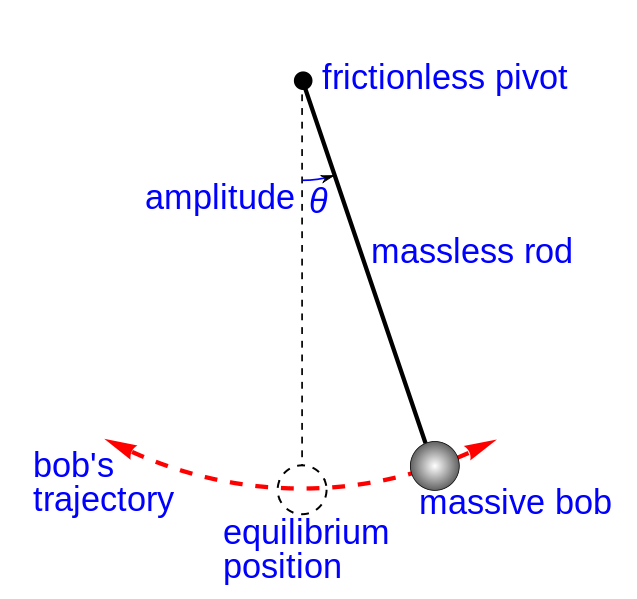
static picture of a pendulum bob given an initial horizontal displacement
and released to swing freely to produce to and fro motion
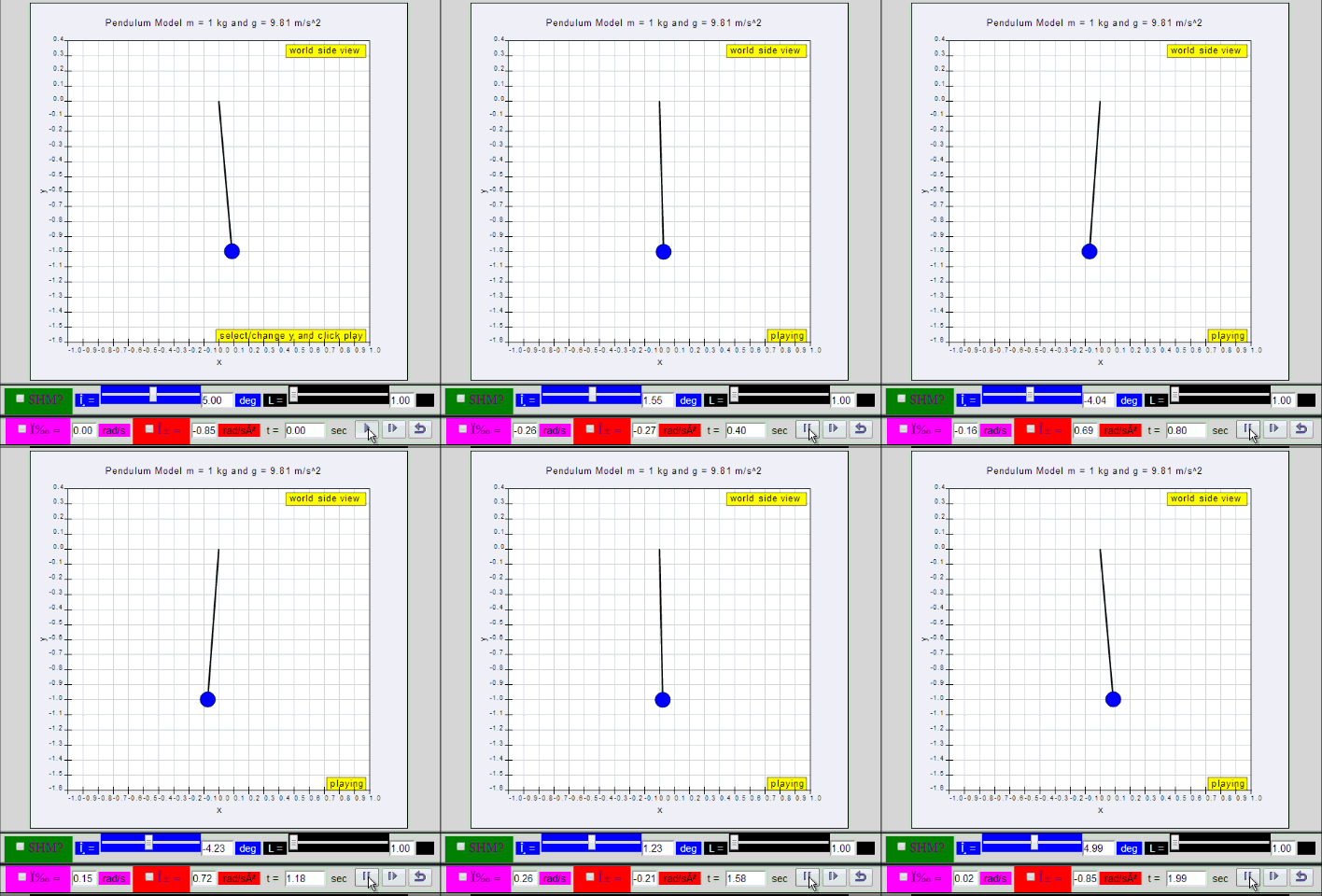
dynamic picture of a pendulum bob given an initial horizontal displacement
and released to swing freely to produce to and fro motion
Run Model:
there are 2 ways to interactive with the models.
- inside the epub3 itself (limited to epub3 size optimize for 600x500
view.
- click on the FullScreen text (for Width at least) to launch into the
browser that understand JavaScript.
