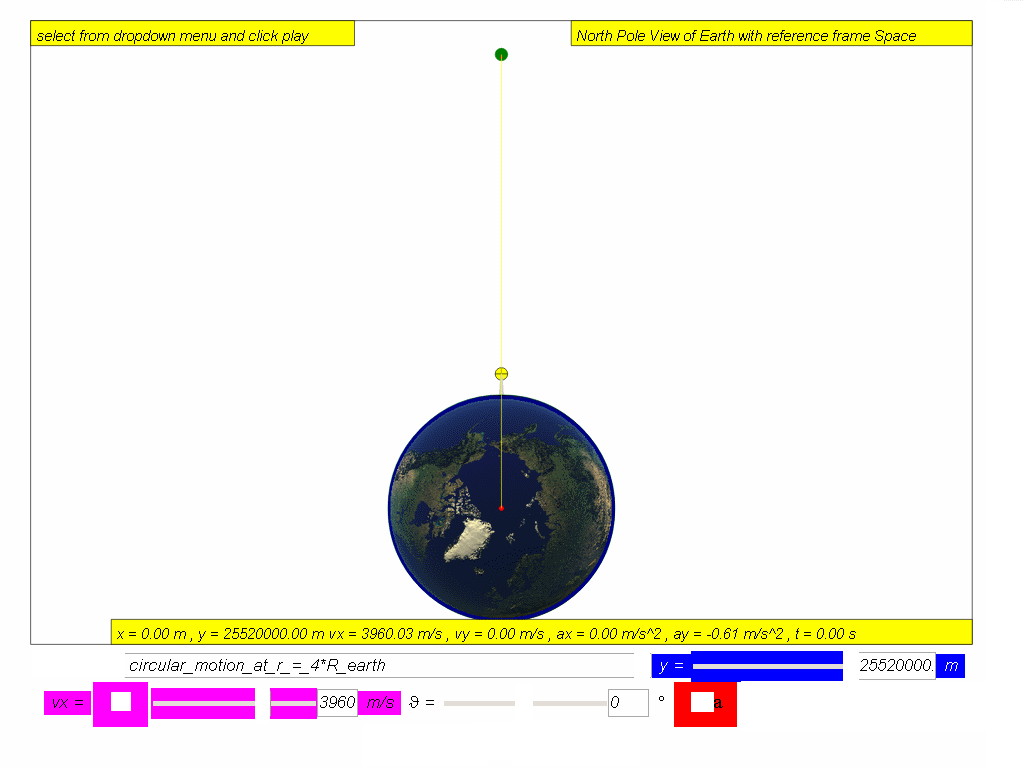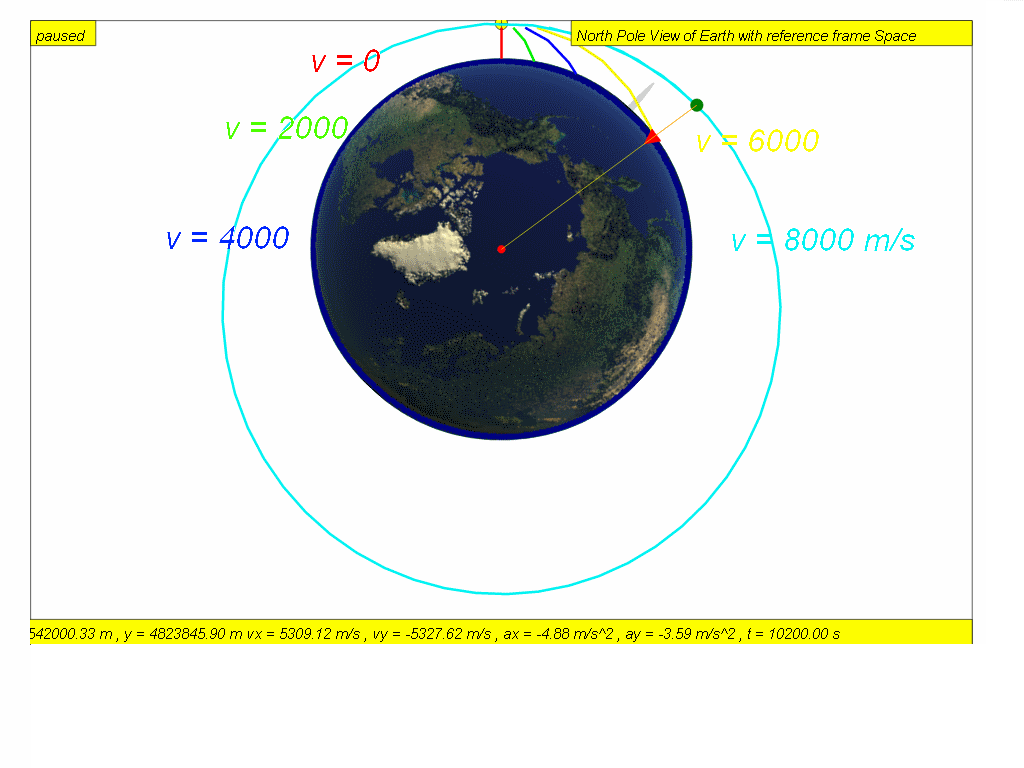
An object projected horizontally near the Earth’s surface follows parabolic trajectories as shown ( v = 0 red, v = 2000 green, v = 4000 blue, v = 6000 yellow and v = 8000 teal) .
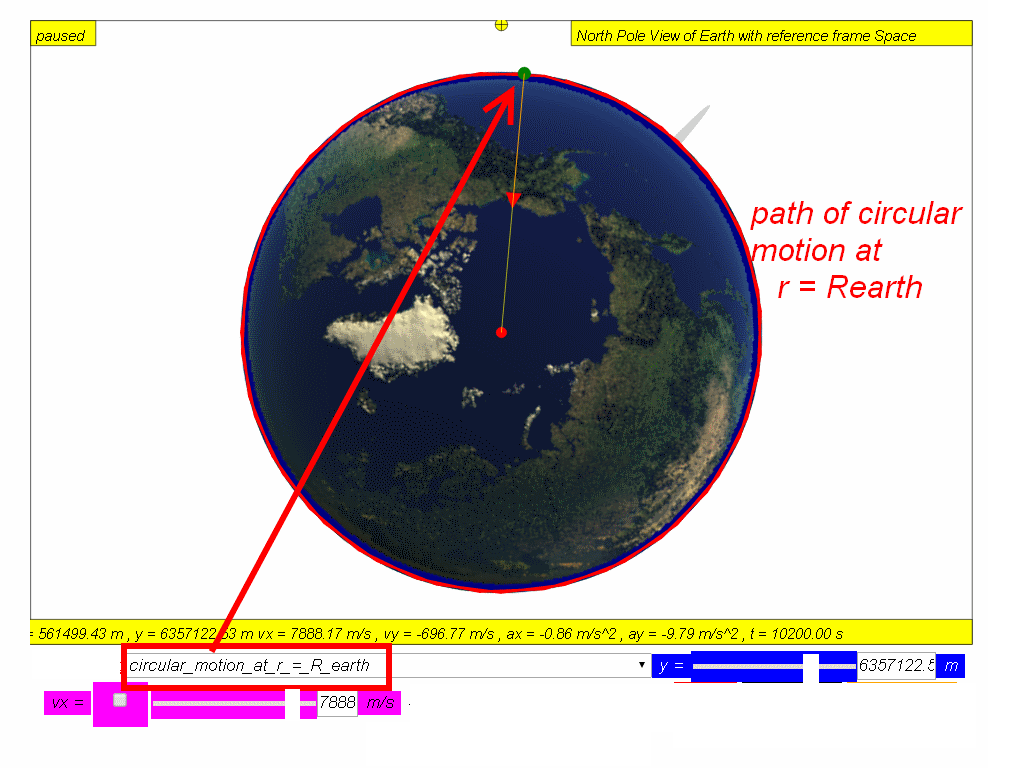
As the speed of projection v increases, the object will reach a speed approximately v = 7888 m/s where the trajectory follows the curvature of the Earth’s surface. [click this for live action now? require internet or scroll down to the model running from hard disk]
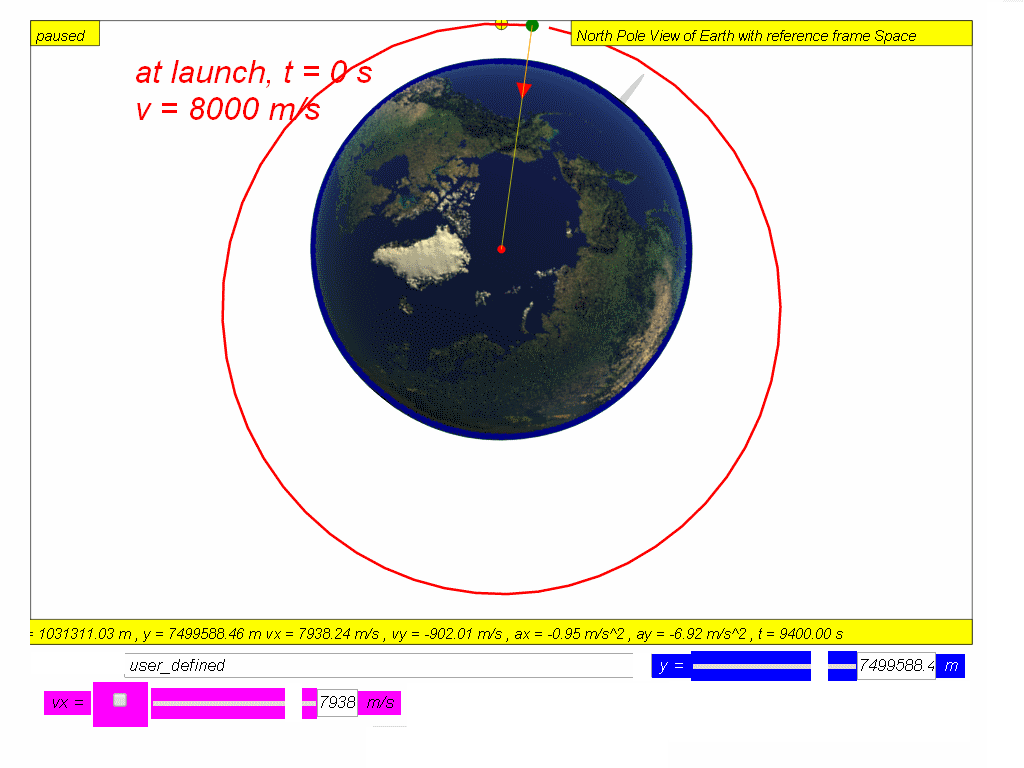
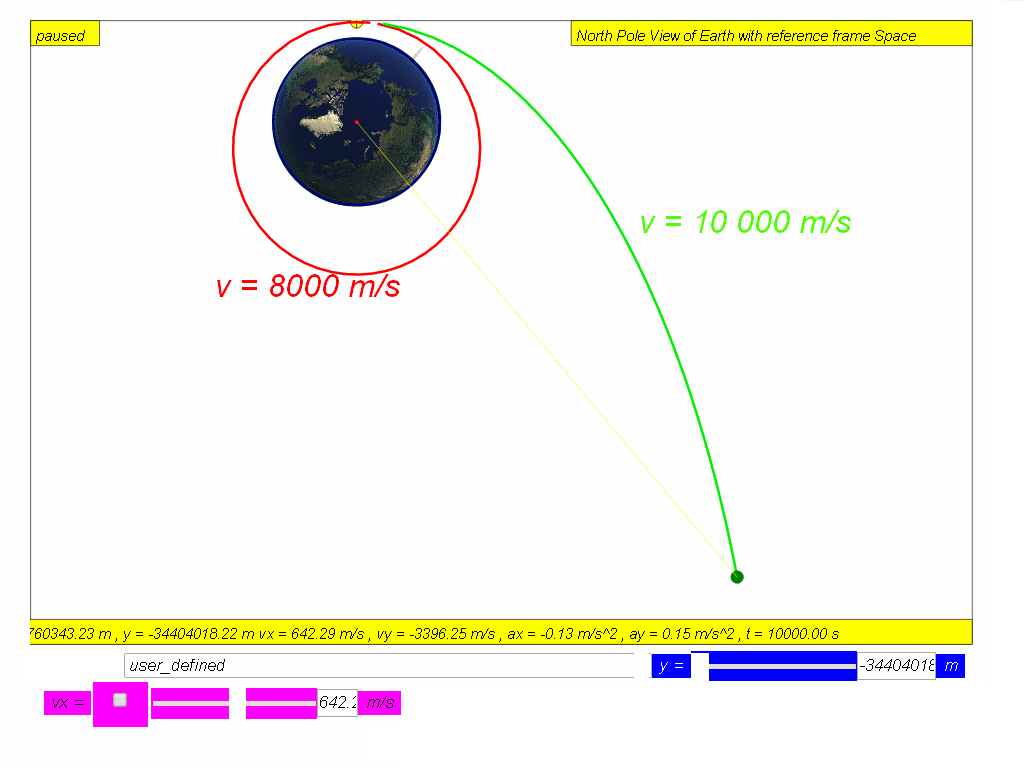
If air resistance is negligible, the object will orbit round the Earth continuously and will never meet the Earth’s surface such as speed v 8000 red m/s and v = 10000 m/s green.
Many man-made satellites move in circular orbits around the Earth. The first man-made satellite, the Sputnik 1, was launched by Soviet Union in 1957. Since then, thousands of satellites have been launched into orbit around the Earth. The only force acting on a satellite in a circular orbit (achieved by launching horizontally at vx =7276.69 m/s at height above Earth surface H = 0.185 RE where RE = 6370 000 m is the radius of Earth, is the Earth’s gravitational force. The gravitational force (red arrow is directed towards the centre of Earth) is also the the centre of the circular orbit.
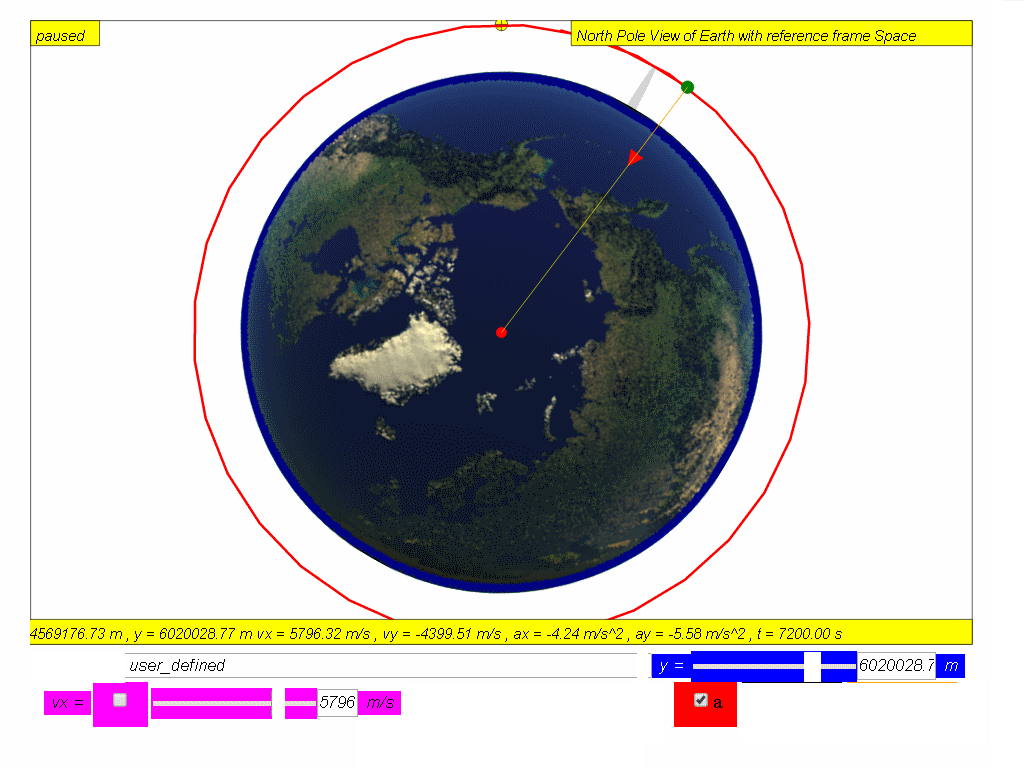
Since the satellite velocity (magenta arrow) is perpendicular to the
gravitational force (Red arrow), its magnitude of velocity remains
constant while its direction changes.
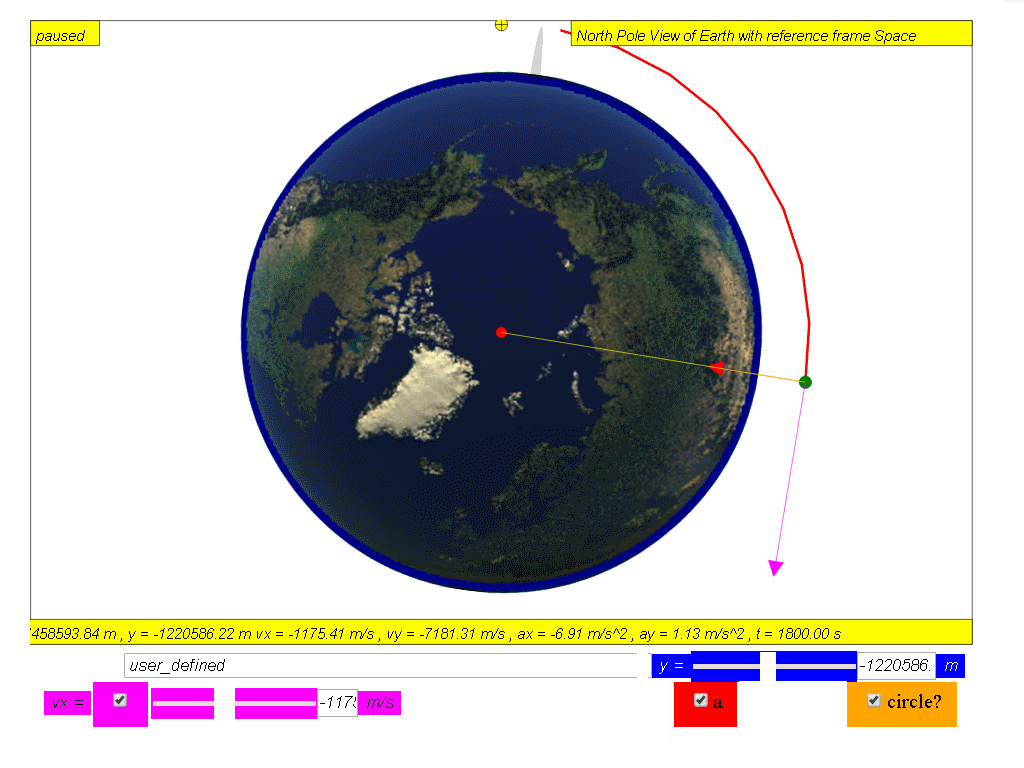
This means that the satellite is traveling in a uniform circular motion
. At the same time, the distance from the satellite to the centre of
Earth will also remain constant in this circular orbit.
For a satellite (or any object) in circular orbit, the gravitational force
acting on it is the centripetal force that keeps it in circular motion.
Using Newton's second law in this context of a circular motion orbit.
Since in outer space, the assumption is only Earth's gravitational field is responsible for the circular motion and gravitational force is
thus,
the expression can be simplified to give the exact velocity required for circular motion .
This equation-formula can be used to calculate the speed required for any object to orbit around a planet of mass M at a constant distance-radius of orbit r
where r is the radius of orbit from the centre of Planet M,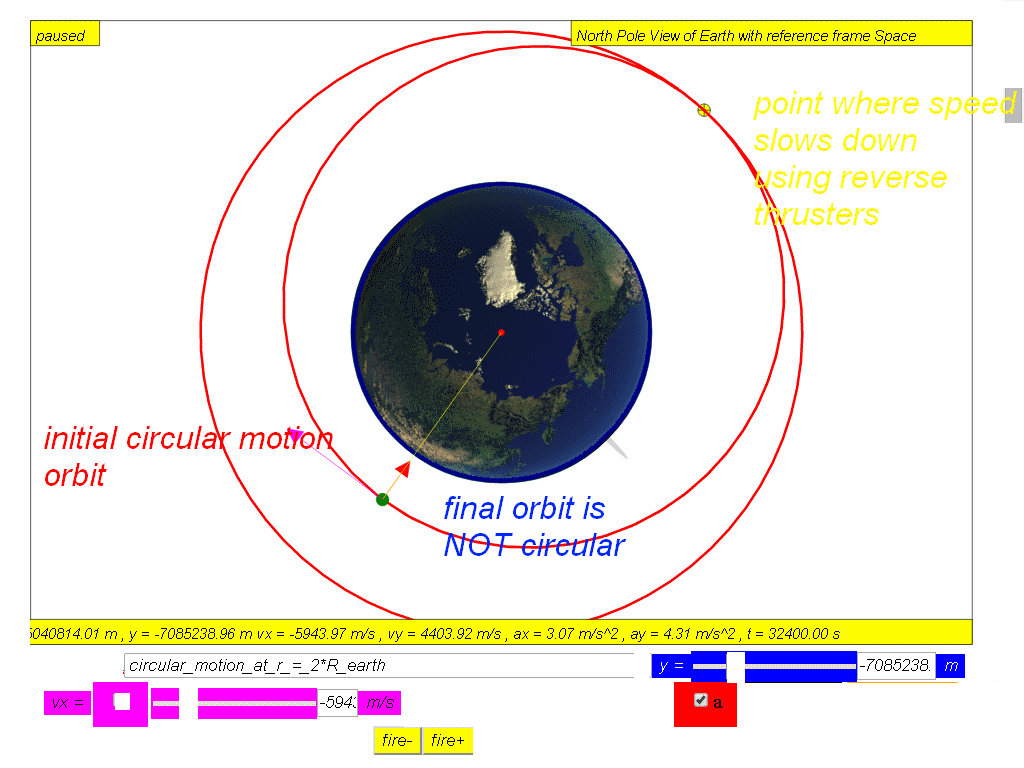
The desired outcome is to allow the students to experience real orbits are not always perfectly circular (a common misconception for students). Real life orbits are usually elliptical.