In Work, Energy & Power, the calculation of gravitational potential
energy (GPE) is determined using the formula, mgh, which assumes that the
gravitational field strength g is roughly constant, but a more robust
formula is required for varying field strength, say when sending rockets
which travel into outer space from the surface of the Earth.
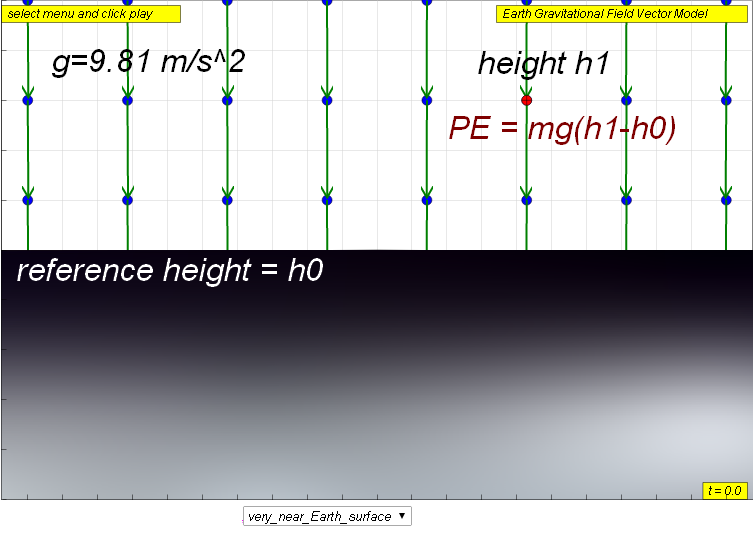
ߡU = ߡPE = mgh or mgߡh
where ߡPE or ߡU is the gravitational potential energy possessed by mass m measured from the reference height h1
g is the gravitational field strength created by source mass M, typically it is the Earth if used on this planet
h or ߡh is the change in the height (h1 - h0 ) of the mass m.
This formula PE = mgh or mgߡh was appropriate because the magnitude of gravitational field strength, g of Earth was assumed to be constant (9.81 m s-2) over this height.
The more robust formula that can account for varying g in the calculation of potential energy is
where
U is the PE is the gravitational potential energy possessed by mass m measured from the reference position at infinity
G is the gravitational constant, approximately 6.673×10⁻¹¹ N·(m/kg)2
M is the source mass that sets up the gravitational field
r is the distance away from the centre of the gravitational field source mass M
In the case when the object is moved through a large change in height (relative to the Earth’s radius), the assumption that g is constant cannot be valid. Hence, to find the gravitational potential energy, U of mass m placed at a distance r away from a source mass M that sets up the gravitational field, the formula used is
To understand this formula:
• Gravitational potential energy is a scalar quantity (i.e. it has no
direction and a negative value simply means it is less than zero).
• This expression implies that U is always negative (less than zero) and the larger
the r, the smaller the value of and hence the larger the value of U = .
(For eg. – 2 is larger than – 4)
• When the object is moved to an infinitely far place where r = ∞, U
becomes zero (which implies maximum gravitational potential energy, since
zero is larger than any negative values).
• Note: by convention, infinity is taken as the reference level, which
has zero gravitational potential energy. However it is the maximum U,
instead of the minimum U!
Now, this leads to the definition of gravitational potential energy, U of
mass m placed at a distance r away from a source mass M that sets up the
gravitational field:
the work done in bringing the point mass
from infinity to that point.
To understand this definition:
• Note that the work done to bring the mass m from infinity (somewhere
infinitely far) to a particular point in space is carried out by an
external force (not the gravitational force by source mass M).
• Since the mass m will be attracted towards the source mass M by its
gravitational force, the external force acting on mass m will be pointing
away from the source mass M, so that mass m can be placed/stopped at that
particular point.
• Draw the external force F and displacement s in the diagram below.